the TOUR BALI
Organize Tour and Adventure in Bali


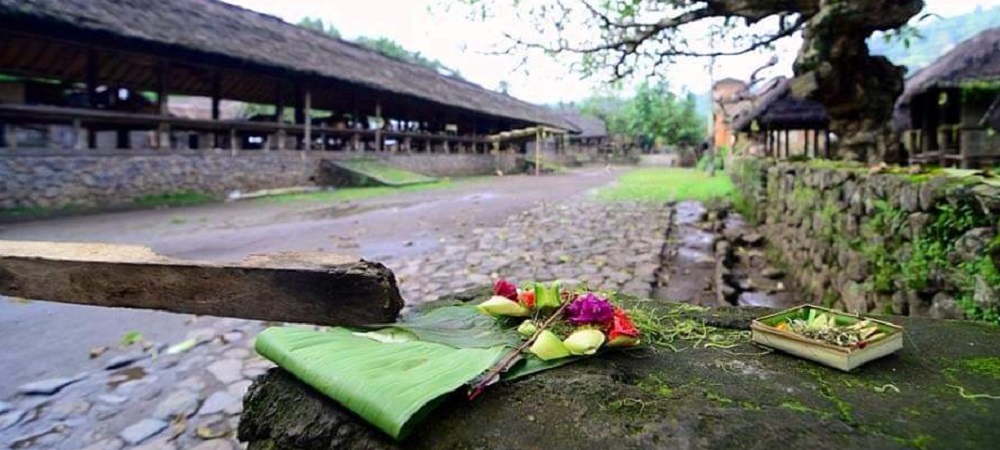
Tenganan Pegringsingan is a traditional village on the island of Bali. This village is located in Manggis District, Karangasem Regency in the east of the island of Bali. Tenganan can be reached from the tourist spot of Candi Dasa and is located about 10 kilometers from there. Tenganan Village is one of the three villages of Bali Aga, apart from Trunyan and Sembiran. Bali Aga is a village that still maintains a pattern of life whose community order refers to the traditional village rules passed down from their ancestors. The shape and size of the building and yard, the arrangement of the building's layout, and the location of the temple are made by following customary rules that have been maintained from generation to generation.
The origin of the word Pegringsingan comes from the work of local people who as craftsmen weave Gringsing cloth, which is the only business found in Bali. Where if you hear the word gringsing, it is definitely synonymous with Tenganan, because only in Tenganan produces the best gringsing with the best quality. Gringsing cloth is the only traditional Indonesian woven fabric made in Tenganan village using the double-tie technique and takes 2-5 years. The Tenganan people have hundreds of years old gringsing cloth which is used in special ceremonies. The word gringsing comes from gring which means 'sick' and sing which means 'no', so that when combined it becomes 'not sick'. The meaning contained in the word is like a repellent to reinforcements
The story begins with a kingdom led by a very powerful but arrogant and arrogant king named King Mayadenawa Bedahulu. During his reign, all the people of Peneges Village in the area of the Bedahulu kingdom were prohibited from carrying out religious ceremonies or worshiping at Besakih Temple. This situation made the gods in heaven angry with Mayadenawa's behavior. It was to fight the very powerful king that Bhatara Indra came down to the world (mercapada). In this battle, finally Bhatara Indra defeated King Mayadenawa Bedahul.
The victory over Mayadenawa's death was celebrated by Peneges residents. Where Bhatara Indra ordered the residents of Peneges to return to praying at the Besakih Temple. This victory ceremony is named Asua Medayadnya, which is a sacrifice (caru) ceremony using a white horse named Onceswara. When the ceremony was about to be held, the Onceswara horse suddenly disappeared. Bhatara Indra ordered all Peneges residents to look for the horse. Then the Peneges residents divided the group into two groups. The first group tracks to the northwest and the second group tracks to the northeast. The group tracking to the northwest was unable to find Onceswara's horse. Then they built and settled in the Beratan area. A second group tracking to the northeast manages to find the horse but is dead. They were very sad because Onceswara's horse was dead.
Bhatara Indra knew this situation and said "O ... Peneges people, don't be sad, even though you find Onceswara's horse dead, I will repay you for your services. For that I bestow this area to you. Regarding the area to the limit where the carcass of Onceswara's horse can be smelle". Hearing the word, the people of Peneges then cut up the carcass and threw the horse pieces in all distant directions, so that they could more broadly control the area. We can see this situation until now with the existence of megalithic remains which the local people consider as holy places or places of worship.
The process of making gringsing cloth from start to finish is done by hand. The threads used are hand spun with traditional spinning tools, not machines. The thread is obtained from kapok with one seed imported from Nusa Penida because only in that place can one-seeded kapok be found. After finishing spinning, the threads will undergo a process of immersion in hazelnut oil before proceeding to the tie and dyeing process. The immersion can last more than 40 days to a maximum of one year with water changes every 25-49 days. The longer the soaking, the stronger and softer the thread will be.
Candlenut fruit (Aleurites moluccana) is taken directly from the Tenganan forest and the gringsing cloth maker must use the fully ripe candlenuts, and fall from the tree. This is in accordance with the awig-awig (customary rule) which states that certain types of trees (candlenut, keluak, tehep, and durian) that grow on individual land should not be picked by the owner, but must be allowed to ripen on the tree and then fall. .
The yarn will be spun into a piece of cloth which has a certain length (weft side) and width (side of the function). To tighten the weave, the thread will be pushed using a bat bone. The finished fabric will be tied by a tie-maker following a predetermined pattern. The binding process uses two colors of raffia, namely pink and light green. Each bond will be opened according to the color dyeing process to produce the appropriate motif and coloring.
The thread arrangement, tying, and coloring are carried out on the weft and weft sides, so that the technique is called double-binding. In the usual tie-weaving technique, generally only the weft side is given a motif, while the function side is just plain thread, or vice versa. The pattern made on the fabric must be woven with skill and precision so that each color on the function will meet the same color on the weft and produce a fabric motif that looks firm.